
Experts call for stronger policy, increased investment to unlock Nigeria’s recycling potential

Experts in the recycling ecosystem have called for stronger policy enforcement, increased investment, long-term financing, improved infrastructure, technology adoption and behavioural change to unlock Nigeria’s recycling potential and transform waste into economic value.
The experts who are environmental advocates, waste managers, recycling practitioners and private-sector stakeholders believe that for such potential to be unlocked intentional approach has to be taken.
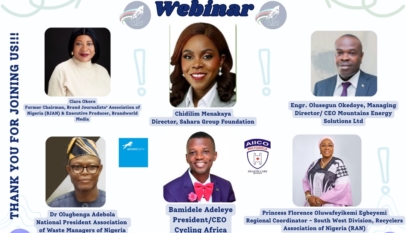
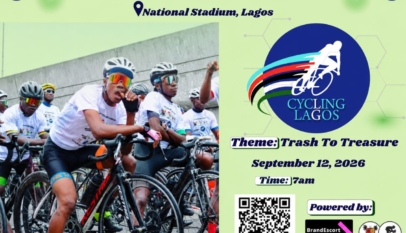
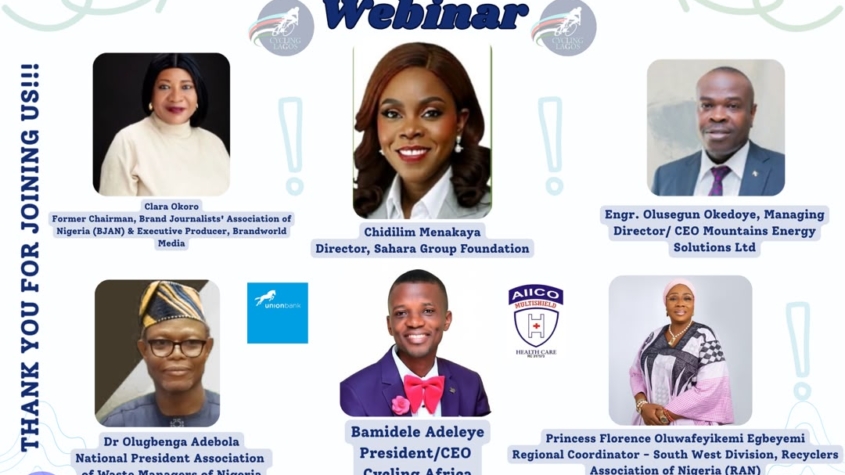
They made the call at the 5th Cycling Lagos Webinar, held on Thursday, September 3, 2026, as part of activities leading up to the 5th Cycling Lagos scheduled for Saturday, September 12, 2026, at the National Stadium, Surulere, Lagos.
The webinar, themed “Trash to Treasure: Unlocking Recycling Capacity for a Sustainable Future,” brought together industry experts and stakeholders to examine practical ways of expanding recycling capacity, strengthening the circular economy and addressing Nigeria’s growing waste management challenges.
Speaking at the event, the National President of the Association of Waste Managers of Nigeria (AWAMN), Dr. Olugbenga Adebola, said Nigeria must stop treating waste solely as an environmental problem and begin to recognise it as an economic resource.
“Waste is not waste unless you waste it. For a very long time, whether in Lagos, across Nigeria or across the continent of Africa, we have been wasting our waste,” he said.
Adebola stressed that accurate data was critical to effective waste management planning, particularly in Lagos, where he said current estimates may not adequately reflect the actual volume of waste being generated.
According to him, planning for approximately 13,000 metric tonnes of waste when actual generation exceeds 20,000 metric tonnes creates a significant deficit in collection, transportation, processing and disposal infrastructure.
He noted that although approximately 18 per cent of waste generated in Lagos is currently recycled, the figure remains low considering the enormous volume of recyclable materials entering the waste stream.
While acknowledging Lagos State’s pioneering role in waste recovery and recycling, including the promotion of the Three Rs — Reduce, Reuse and Recycle, Adebola identified infrastructure, financing and policy implementation as major constraints to the sector’s growth.
He said waste management and recycling were highly capital-intensive businesses requiring affordable, long-term financing to attract and retain private investment.
“I have invested hundreds of millions of naira into recycling, and I am not making what I am supposed to be making. If I had gone to the bank to borrow the money, I would be in trouble today,” he said.
Adebola advocated financing arrangements of between 10 and 15 years, noting that short-term commercial bank loans and high interest rates were unsuitable for funding large-scale waste management and recycling infrastructure.
He cited the cost of a new compactor, which he said could exceed N150 million, as evidence of the scale of capital required in the sector.
He called for stronger government-private sector collaboration, including long-term concession agreements that would provide investors with sufficient certainty to commit substantial capital.
Adebola also highlighted the economic contribution of the private sector, disclosing that AWAMN members had collectively contributed to the creation of more than 30,000 direct and indirect jobs across waste collection, transportation, vehicle maintenance and related activities in Lagos.
He further highlighted the role of workers operating behind collection trucks in recovering recyclable materials, saying they account for a significant proportion of recyclables recovered in Lagos.
Investment, Behavioural Change Critical
The Director of Sahara Group Foundation, Chidilim Menakaya, also called for increased investment in recycling infrastructure, technology, financing and public education.
Menakaya explained that Sahara Group Foundation serves as the social impact vehicle of Sahara Group, leveraging an “Extrapreneurship” strategy that combines economic and community empowerment initiatives through strategic partnerships.
She said the Foundation’s interventions align with the 17 Sustainable Development Goals, noting that more than two million people have benefited from the Group’s social impact projects and initiatives.
Speaking on the topic, “Trash to Treasure: The Role of the Private Sector in Unlocking Recycling Capacity for a Sustainable Future,” Menakaya described the country’s growing waste stream as both an environmental challenge and an economic opportunity, saying that the private sector has a critical role to play in bringing capital and investment into the sector to drive its transformation.
“Most of this waste is actually wasted instead of being turned into opportunities,” she said.
She stressed the need for a more structured system of collection, sorting and recovery that would prevent recyclable materials from ending up in landfills and instead channel them into productive economic activities.
According to her, the recycling value chain requires coordinated investment in collection systems, sorting and recovery facilities, recycling trucks, processing plants, technology and reliable off-takers.
“The government has a part to play in ensuring that we have the right policies, while the private sector brings capital and investment,” she said.
Menakaya, however, warned that infrastructure and investment alone would not solve Nigeria’s recycling challenge without behavioural change.
“If the public do not understand the reason why they have to recycle, there is no need for you to put infrastructure in place,” she said.
She called for stronger community education and sensitisation to communicate the environmental, personal and economic benefits of recycling.
Menakaya also urged entrepreneurs and young people to see waste collection and aggregation as viable businesses.
“A lot of people have not understood that collection is a big business and that collection is a profitable business,” she said.
Recycling Must Become Industrial Policy
The Regional Coordinator, South-West Division of the Recyclers Association of Nigeria (RAN), Princess Florence Oluwafeyikemi Egbeyemi, said Nigeria needed to fundamentally change its approach to recycling by moving beyond waste collection to industrial transformation.
Speaking on the topic, “The Role of Recycling in Nigeria’s Circular Economy”, she described recycling as more than a sanitation programme, saying it should be treated as industrial policy, urban infrastructure and resource security.
“The question is: how do we move from simply collecting waste to transforming it into reliable industrial value? That is the journey from waste collection to industrial transformation,” she said.
According to Egbeyemi, Nigeria is generating enormous quantities of materials while industries simultaneously require reliable raw materials, creating an opportunity to connect waste recovery with industrial production.
She said the real measure of success should not simply be the quantity of waste collected but the volume of recovered materials transformed into specification-grade feedstock that industries are willing to purchase.
“Waste becomes material. Material becomes feedstock. Feedstock becomes product. And product creates value,” she said.
She argued that a tonne of recovered material sitting in a warehouse does not necessarily constitute economic success unless it can be processed into quality material with a reliable market.
Egbeyemi identified poor product design, inadequate source separation, inefficient collection and logistics, contamination, insufficient processing equipment, energy challenges, inadequate working capital and unstable markets as some of the points where value is lost across the recycling chain.
The webinar was moderated by Clara Okoro, Former Chairman, Brand Journalists’ Association of Nigeria and Managing Director Brand World TV
The 2026 edition of Cycling Lagos will hold on Saturday, September 12, 2026, at the National Stadium, Surulere, Lagos, and is expected to attract cyclists, environmental enthusiasts, corporate organisations, government representatives and other stakeholders.
Do you have a compelling story to tell? Contact us via our email: espinewsng@gmail.com or call/WhatsApp on 08032519246.