

The normalization of deviance: How Nestle Nigeria is changing a ‘die hard’ habit

By Amechi Obiakpu
It was American Sociologist and professor, Dr. Diane Vaughan who conceptualized the theory of the Normalization of deviance. The theory, as postulated in her 1996 book, The Challenger Launch Decision, Dr. Diane said, is a social and psychological process where breaking a safe rule or standard becomes accepted as normal.
According to her, this happens when people take a shortcut or ignore a safety step without immediate repercussion. Over time, they forget the rule matters and the bad habit becomes the new standard.
Everywhere in our daily lives, this is experienced: from the students who ‘cheat’ their way through school, because they are not caught during exams, it eventually appears normal; to the individuals who allow running water from the tap to flow unattended to not minding that the action impact negatively on the global volume of water reserve. Through to the indiscriminate dumping of waste into drainage systems and unauthorized open dumpsites which violates public health and environmental codes, leaving the environment in ruin, in the long run.
Enter Nestle Nigeria
To break the normalization of deviance cycle, Nestle Nigeria as a responsive and responsible organization, has consistently taken its message of change and advocacy to Nigerians and at every country of its operation. In Nigeria for example, for years, the “good life” brand has collaborated with different groups including the media to bring to consciousness the consequences of bad actions that appear good and the impact on the environment.
Take for example, the Nestlé Advancing Nutrition, Health and Environmental Awareness through the Media initiative which it is partnering with the Lagos Business School (LBS) Sustainability Centre, for several years, equipping journalists and media practitioners to enhance their ability to communicate to the Nigerian populace on best practices, lifestyle choices, and policy direction that fosters sustainability of lives, communities and the environment.
As at 2024, more than 300 journalists and media practitioners had passed through the program and had become ‘change agent’, in the advocacy of environmental safety and positive lifestyle choices.
What the record says
According to World Bank estimates, roughly 33% of global municipal solid waste is directly dumped in the open or burned without environmental safeguards. In low-income nations, this figure rises to over 90%. On the other hand, plastics entering the oceans is estimated at 8 to 11 million metric tons annually, primarily driven by mismanaged and open dumping in coastal regions and near major river basins.
Narrowing it to Nigeria, it says an approximately 32 million tonnes of municipal solid waste (MSW) per year, is generated annually, making it one of the largest waste producers in Sub-Saharan Africa. This volume is projected to reach 107 million tonnes by 2050.
Experts say in many urban centers including Lagos and Port Harcourt, blocking gutters with single-use plastics and burning refuse openly is a daily routine. Because community waste infrastructure is consistently overwhelmed or absent, citizens and local authorities accept open-air burning and choked waterways as a standard, baseline reality rather than a policy failure.
For them, Nigeria must shift from a culture of “firefighting” and institutional oversight to strict accountability. An accountability that involves holding every one of us responsible for some of the failures, if not all, not just people in authority.
Nestle and partners collaboration
Beyond talk, Nestlé Nigeria alongside coalition partners, embarked on a nationwide environmental action to rid the environment of waste and other harmful materials.
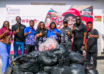
The campaign in commemoration of the 2026 World Environment Day community sensitization and clean-up campaign across 12 locations nationwide, brought together volunteers, communities and stakeholders in coordinated action to support environmental stewardship and responsible waste management.
Through the efforts of 424 volunteers, a total of 4,507.8kg of solid waste and 48.2kg of recyclable waste was recovered, according to reports from the African Clean-Up Initiative (ACI) and the Recyclers Association of Nigeria (RAN).
The recovered waste was channelled through appropriate recycling and disposal pathways, contributing to cleaner public spaces and supporting broader efforts to reduce waste leakage into the environment.
The nationwide activation was driven by Nestlé Cares volunteers, the company’s employee volunteering programme, alongside volunteers from the 15 organisations participating in the coalition.
From Lagos through to Abuja, Agbara, Jos, Kano, Enugu, Awka, Ota, Abaji, Sagamu, Port Harcourt and Ibadan, volunteers worked alongside community members in structured clean-up and sensitization activities designed to strengthen environmental awareness and encourage responsible waste management practices. The initiative was delivered through a coordinated multi-stakeholder framework, bringing together government institutions, regulators, industry platforms, development partners and recyclers to support implementation and ensure alignment with national environmental priorities.
Reaction
Commenting on the initiative, Victoria Uwadoka, Lead Corporate Communications, Corporate Affairs and Sustainability, Nestlé Nigeria, said environmental progress is most sustainable when communities see themselves as active participants rather than observers.
“What encouraged us most this year was not only the volume of waste recovered, but the willingness of volunteers, partners and community members to work together towards a shared goal,” she said.
Uwadoka noted that, lasting environmental progress depends on that sense of collective ownership, and it is often through small actions taken together that meaningful change begins.
At the Abuja activation, the Honourable
Minister of Environment who was represented by the Director of the Pollution Control and Environmental Health Department, Federal Ministry of Environment, Mrs. Adeola Omotunde pointed that addressing environmental challenges requires consistent action at all levels.
“Initiatives such as this demonstrate how government, private sector and communities can work together to drive responsible environmental practices and deliver real impact,” she said.
On her part, the representative of the Country Manager of the National Plastics Action Partnership (NPAP), Mrs. Esther Chibueyin Fagbo, said: “Nigeria’s plastic pollution challenge requires bold, collaborative action, and this initiative demonstrates the value of bringing together communities, partners and the private sector around a shared goal. We are proud to have supported this effort and look forward to continuing our collaboration to advance circular economy solutions that create environmental and economic value.
As Nestlé Nigeria continues to work with partners, communities and stakeholders to create shared value, the initiative demonstrates how collective action can contribute to cleaner environments, stronger waste recovery systems and more sustainable communities. The company remains committed to supporting collaborative approaches that help advance circular economy outcomes across Nigeria.
Other record
According to google, formal waste collection agencies capture only 20% to 30% of total waste generated nationally.
The remaining 70% to 80% is dumped indiscriminately in drainages, open plots, and rivers, or burned. In the plastic waste scale, Nigeria generates roughly 2.5 million tonnes of plastic waste annually.
About 50 to 60 million single-use plastic water sachets are used and discarded every single day, contributing heavily to drain blockages.
The recycling rate, the platform says is fewer than 10% of recyclable materials are formally collected and recycled, leaving informal waste pickers as the primary resource of recovery network.
Waste management expert and former Public Affairs Director at Lagos State Waste Management Authority (LAWMA), Folashade Kadiri, said there was the need for attitudinal change.
For her, human attitude towards environmental cleanliness is a complex issue influenced by various factors, including cultural norms, socioeconomic status, attitudinal behaviour and education, stating that, “while there are individuals who prioritizes cleanliness and take active steps to maintain a clean environment, there are also those who disregard waste management practices and contribute to pollution.”
“This often stems from a lack of awareness about the consequences of littering and improper waste disposal, as well as a perceived lack of responsibility for public spaces.
She admitted though that, while there have been significant improvements in waste management efforts by operators and the government, it’s undeniable that there is still a gap in the level of public participation.
Conclusion
On an individual level, human behaviour has completely normalized micro-crimes against the environment.
In a situation where a consumer drops it’s waste on the ground rather than properly disposing it in the bin, after emptying the content and normalises it.
The action may not bring immediate consequence but it will contribute to the degrading of the environment in several years to come especially as millions of people continue to do the same.
However, with the campaigns and advocacy from organisations like Nestle Nigeria and other stakeholders, this deviance will continue to reduce especially as the dangers of such action is constantly reinforced on a regular basis through different enlightenment and awareness campaigns deployed by Nestle Nigeria in collaboration with other stakeholders.
Do you have a compelling story to tell? Contact us via our email: espinewsng@gmail.com or call/WhatsApp on 08032519246.